
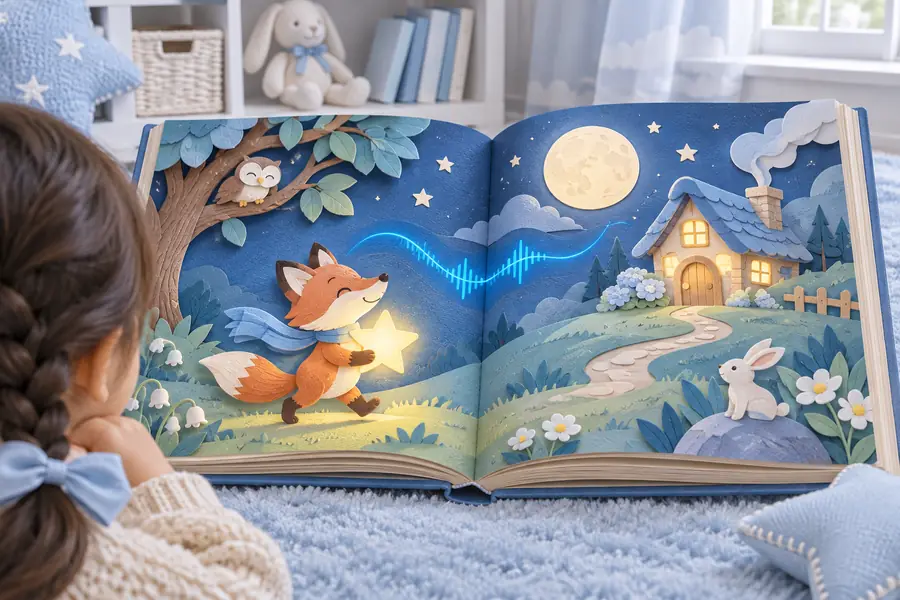

Preschool story time

Make read aloud for preschool a shared conversation

A good preschool story session gives children room to listen, predict, move, and talk. Choose a short text, plan a few pauses, and let their responses shape the pace.

Read Aloud landing-page illustration

Session essentials

What this scenario must deliver

Think of these as the ingredients of a story session, not a script to complete. A child’s question may be more valuable than your next planned prompt.

A workable routine

Each item

Use the same three-part routine with a new story, then change the prompts to fit the children in front of you.

  1. 1

    Choose a story with something to notice

    Look for clear characters, an understandable problem, and pictures or details worth discussing. Before you begin, decide which names or unfamiliar words need a quick explanation. For a group with varied attention spans, choose a natural stopping point rather than assuming you must finish the whole story.

  2. 2

    Read, pause, and invite a response

    Let the opening establish the story before asking questions. Pause at a meaningful change: a character finds something, makes a choice, or faces a surprise. Ask one open question such as “What do you think might happen?” and accept pointing, a gesture, a sound, or a few words as a response.

  3. 3

    Return to one memorable moment

    After reading, revisit a picture, a repeated line, or the character’s problem. Invite children to say the phrase with you, act out a movement, or describe what changed. This gives quieter listeners another way in without turning story time into a test of recall.

Listening first

Quality bar

The difference is not how many questions you ask. It is whether children have enough of the story, and enough time, to offer an answer of their own.

Illustrative short-story visual representing the text selected for a session A story to share
Preschool reading illustration representing a shared story session A story to discuss
These images illustrate the planning shift, not a guaranteed before-and-after result. A useful session lets children hear a connected stretch of story, join in if they wish, and respond without being rushed or corrected for every word.

Adjust the plan

Common rework

If a session feels flat, change one part of the invitation before changing the entire story. Different listeners may need different ways to take part.

The quiet observer

A child watches closely but does not answer when the group is asked a question. Offer two pictures to point to, or invite a gesture that matches the character’s action. Do not require a spoken answer before continuing.

The child can participate without being put on the spot. For a broader set of age-flexible ideas, see the linked guide.

read aloud for kids

The energetic group

Children are restless halfway through the story. Keep the plot moving and give them one repeated action or phrase to perform when it returns, instead of stopping after every page.

Movement becomes part of listening rather than a reason to abandon the story. The toddler guide offers further ideas for brief, physical responses.

read aloud for toddlers

The eager predictor

A child guesses the ending at every turn. Acknowledge the idea, then ask what in the picture or story gave them that clue. Return to the prediction after the next event.

The child has a reason to keep listening and can revise an idea without being told they were wrong. Older-group approaches appear in the linked guide.

read aloud for kindergarten

The mixed-age helper

An older sibling or classroom helper is present. Ask them to model a curious question or join a repeated line, while leaving time for the preschoolers to answer in their own way.

The helper supports the conversation without taking it over. For techniques aimed at much older listeners, see the linked strategy guide.

read aloud strategies for high school

Next story session

Keep the story, make room for their voices

Pick one text and one question you genuinely want to hear children answer. If you want to explore voice reading as part of your preparation, follow the link to the product and check its current options there. You can still pause, repeat, and talk together during the session.

Explore voice reading
  • Choose a story with a clear thread
  • Pause where children have something to notice
  • Welcome words, gestures, and questions

Scenario FAQ

Choose a story with a sequence children can follow and moments that invite noticing or prediction. Repetition and expressive pictures can help children join in, but the best choice also depends on what interests the group.

Follow the children’s engagement rather than a fixed timer. A short story with time for conversation may work better than a longer book rushed to its ending; you can also stop at a natural point and return later.

No. Briefly explain words needed to follow the plot, and let pictures or nearby sentences help with others. Frequent interruptions can make it harder for children to stay with the story.

Give them time, and offer another way to respond, such as pointing to a picture or acting out a choice. Listening quietly is participation too; you do not need to call on every child.

A recorded voice can present a story, but it cannot notice a child’s question and respond in the moment. If you use one, pause it to look at pictures, repeat a favorite phrase, and talk about what the children noticed.

Try text to speech
Try text to speech